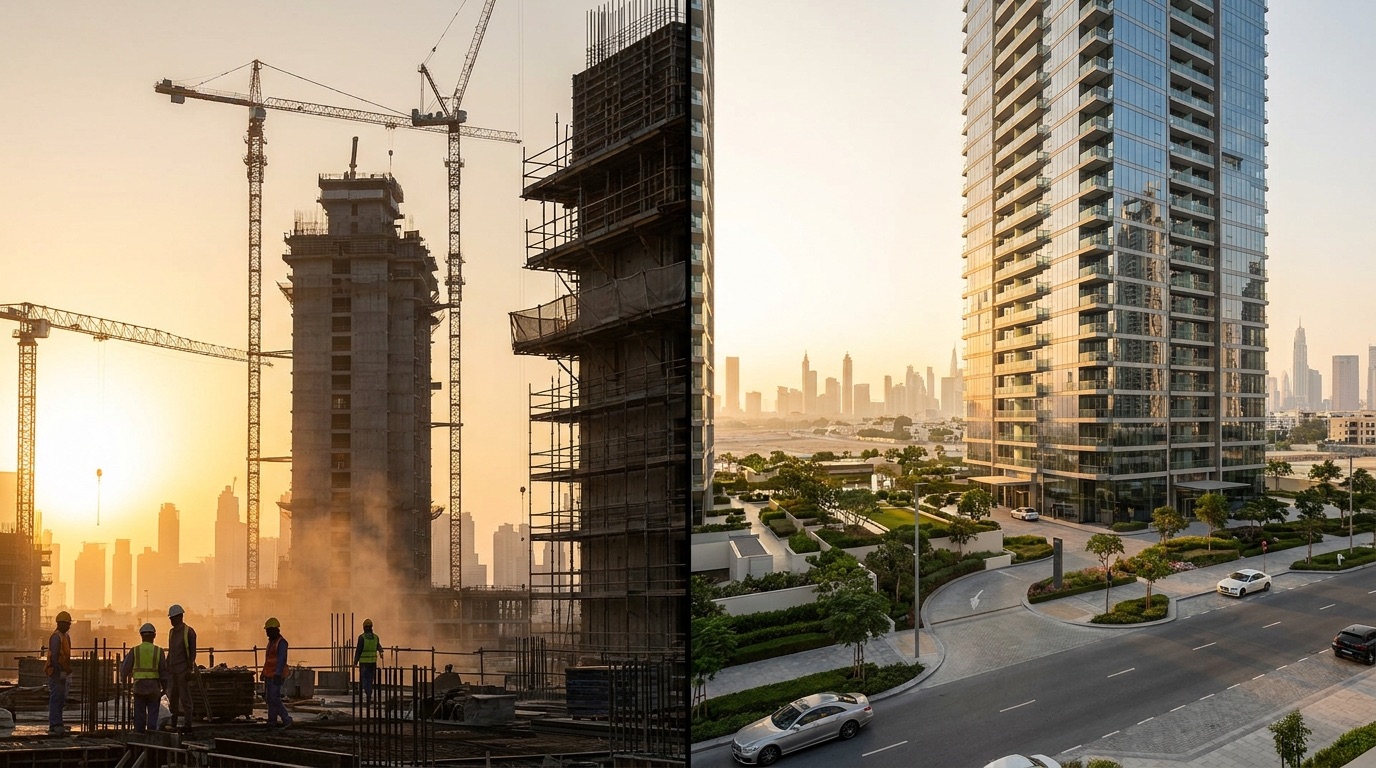
Every Dubai property investor faces the same fork in the road: buy something that exists today, or commit to something still on the drawing board. Both strategies have made investors excellent returns. Both have burned people who chose for the wrong reasons.
Here is the honest comparison.
What the terms mean
Ready (secondary) property is completed and handed over. You can walk through the actual unit, see the actual view, and collect rent from the first month.
Off-plan property is bought from a developer before or during construction, usually on a staged payment plan tied to construction milestones, with handover one to four years away.
The case for off-plan
- Lower entry price. Developers price early phases below the expected completed value to fund momentum. Early buyers in successful projects capture that gap.
- Payment plans spread the cost. A typical structure asks for a percentage down and instalments through construction — some plans even extend years past handover. Your capital is committed gradually instead of all at once.
- New stock, new standards. Latest layouts, amenities, and efficiency — and nothing to renovate.
- Capital growth potential during construction. In rising markets, units can appreciate between launch and handover, and many investors resell before completion.
The case for ready property
- Income starts immediately. A tenanted apartment pays you from day one. Off-plan pays nothing until handover.
- What you see is what you get. No renders, no assumptions — the view, the finish, the building community are all inspectable.
- Established service charges and rental history. You can verify the running costs and what tenants actually pay, instead of estimating both.
- Mortgage-friendly. Financing ready property is straightforward; off-plan financing is more limited.
The risks on each side
Off-plan risks
- Delivery risk. Projects can be delayed, and in rare cases cancelled. Dubai mitigates this with RERA-regulated escrow accounts — your payments fund the project, not the developer's other ventures — but mitigation is not elimination.
- Market risk at handover. You are committing at today's price for an asset delivered in a future market.
- Spec risk. The finished unit may differ from the showroom. Developer track record is your best defence — it is the single most important filter in any off-plan decision.
Ready property risks
- Full capital outlay upfront (or a mortgage from day one).
- Older buildings age. Maintenance and service-charge trajectories matter more with every year.
- You pay market price. The early-phase discount is gone; your return comes from yield and long-term growth.
How to decide: match the strategy to your situation
- You want income now → ready property. Every month without a tenant is negative yield.
- You are building capital gradually → off-plan payment plans let you enter the market without full financing.
- You need Golden Visa eligibility → both routes can qualify at AED 2 million; off-plan from approved developers counts.
- You are risk-sensitive or buying your first UAE property → ready property removes the largest unknowns.
- You believe in a specific district's growth → off-plan in that district is the leveraged version of that view.
Frequently asked questions
Can I sell an off-plan property before handover?
Usually yes, once you have paid a minimum percentage set by the developer (commonly 30 to 40 percent). This is how flippers exit pre-completion.
Is off-plan cheaper than ready in the same area?
At launch, generally yes on a per-square-foot basis. The gap narrows as construction progresses.
What protects my off-plan payments?
In Dubai, developer collections for a project must go into a RERA-supervised escrow account and are released against construction progress.
Compare both in one conversation
The right answer depends on your cash flow, timeline, and risk tolerance — which is a conversation, not a filter setting. Ask dAIr to show you both ready and off-plan options for your budget and it will lay out the trade-offs for your specific situation.